For those who would like to volunteer as docents at the Tollkeeper’s Cottage
1. What the Museum offers you:
§ The opportunity to learn about the history of our roads, and of one of the oldest tollgate cottages (circa 1835) surviving anywhere in Canada, and its surrounding neighbourhood.
§ The chance to improve your public speaking and interpretive skills.
§ The occasion to work a fine group of dedicated volunteers in a convivial setting..
§ The chance to help preserve local history by educating visitors to the Cottage
2. What the Museum asks of you:
§ To learn about the Cottage with the help of our docents, and our library of information. We have lots of interesting reading material!
§ It would be great if you could make your own ‘period dress’ (we don’t call it a costume!), but lots of help is available! Don’t be put off if this is not in your skill set!
§ To spend about one Saturday a month shadowing the present docents, until you are ready to lead tours of the museum on your own.
WHAT IS IT LIKE TO BE A DOCENT AT THE TOLLKEEPER’S COTTAGE?
DO CENTˈdōs(ə)nt/ — definition: a person who acts as a guide, typically on a voluntary basis, in a museum, art gallery, or zoo.
We’re on the lookout for a reliable, enthusiastic person who loves history and enjoys sharing it. We’d like you to be available for one or two Saturdays a month from noon to 5:00 pm, or one Sunday per month from 1:00 – 4:00 pm. Let us know at tollkeeperscottage@gmail.com.
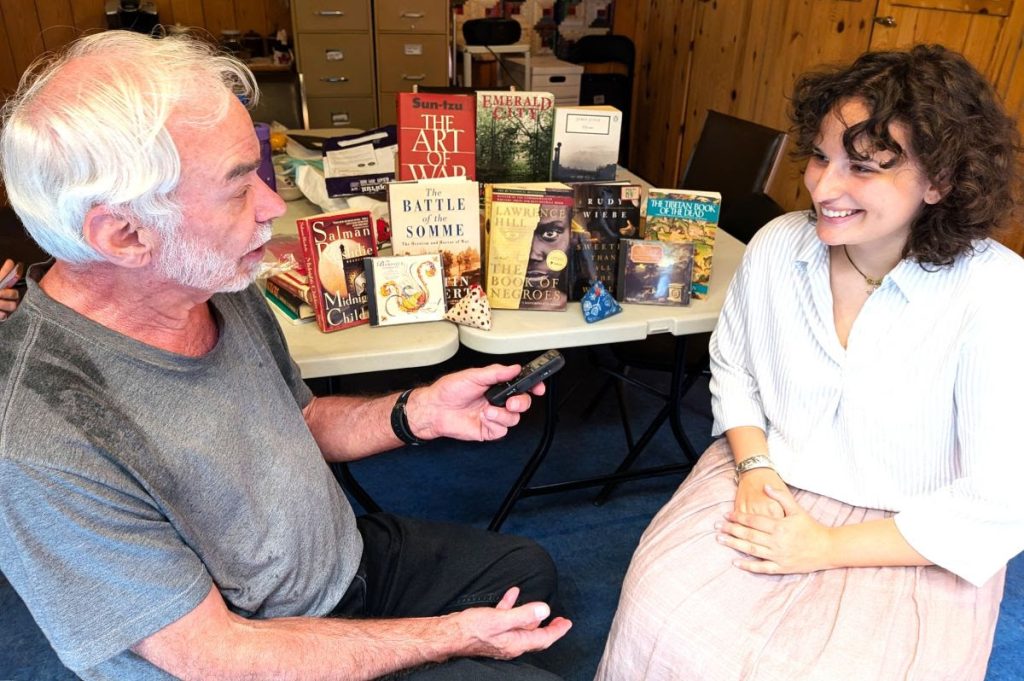
In the photo above, our summer docent Annie Prionas is interviewed by our journalist volunteer, Den Hanagan with a few of our books ready for the upcoming Book Sale. Take a look at the interview below to find out more about how Annie describes her experience this summer at the Tollkeeper’s Cottage and see if this is the kind of thing you’d like to do.
It was by chance that Annie Prionas stumbled across Tollkeeper’s Cottage. And when she did it was love at first sight.
So much so that in the summer of 2025 she decided to become a docent at this little piece of history where the life of a mid-1800s Toronto tollkeeper and his nine-member family is presented to visitors.
When Annie arrives at the Cottage she quickly changes into the style of dress that women in the working class wore back then – an unadorned skirt reaching to the floor, long sleeves to cover the arms, a bonnet, or “mob cap”, and an apron hanging down in front and tied at the back.
“I went to a number of museums in North York where I live and then I discovered the Tollkeeper’s Cottage,” says Annie, a 20-year-old Ottawa University student. “It wasn’t a museum on my list because I had never heard of it. But when I saw they were open and wanted volunteers I was like ‘oh yes!’”
At that point there was no turning back. Annie was sold, not just because she’d be learning about early Toronto life and its history but because she’d also be re-enacting that way of life to help Cottage visitors gain a better understanding of the strenuous – and sometimes dangerous – life of a Toronto tollkeeper.
It’s fitting that Annie likes history. Although she was born in Canada, her ancestral homeland is Greece where history is deeply imbedded in the culture. Her father is a first-generation Canadian. When she visits Greece it’s important for her to reacquaint herself with her roots. “I visit our original village, our original little house that my grandfather and grandmother lived in,” says Annie.
“My grandmother is from the mountains but my grandfather is from the plains so we’ve never really been close to the sea. I come from a long history of farming and mountain goat herders,” says Annie.
The sea is just an hour away wherever you go in Greece but not everybody has a car, says Annie. “Greece is a European country but it’s still a little bit behind. Many of the roads are still made for a donkey and cart.”
When on duty at Tollkeeper’s Annie enjoys telling visitors about “the coconut.” Yes, Tollkeeper’s Cottage has a coconut as part of its history and it made tollkeeper John Bulman’s job a little easier.
“When the tollkeeper or other member of the family were collecting tolls from the people passing by they would have this hollow coconut on a stick they would hold up to the wagon driver,” explains Annie. “The wagon driver would put his pence in and then he’d be on is way. The price changed depending on who was coming through the gate – and not everybody paid,” says Annie. In fact, Bulman or a family member would quickly jump out of the way if a traveller wasn’t in the mood to render a few pence. “I know they would just sometimes run right through the gates.” says Annie. And that’s where the job took on a little bit of danger. But there was no danger-pay to go with it.
Actually, there was no pay at all to go with it, says Annie. The only thing the Bulman family – mom, dad, the four daughters and three sons – got for all their hard work was the cottage to live in.
“Being a tollkeeper was not an admirable job,” Annie has learned. “You didn’t make much, you didn’t make anything. You just had the house to live in. That’s how you were compensated.”
The Bulmans had a farm next to their cottage where they could grow their food. They also sold or traded milk from their cow; or the oats, barley or potatoes from their rented farm plot.
She points out to cottage visitors how modern conveniences contrast so greatly with the mere basics the Bulman family lived with.
“Every time I show them the pails of water they carried to and from Taddle Creek, every time I show them the chamber pot, every time we talk about the beds and how uncomfortable they probably were, I think it helps people realize how hard life was back then.”
Annie admits she’s a romantic at heart and relishes telling visitors how Mr. and Mrs. Bulman met. It’s her favourite Tollkeeper’s story. “Mrs. Bulman was from a better-off family in England and Mr. Bulman was their gardener,” says Annie. “They fell in love but her family didn’t approve so they sent her to Toronto to live here.”
But gardener Bulman wasn’t going to let 5500 kilometres and an ocean get in his way. “He followed her to Canada and they got married,” says Annie.
At university Annie is working toward an Honours Bachelor of Social Science Degree in anthropology and sociology. When she returns there in September she’s anxious to tell her friends about Tollkeeper’s.
“I’m going to go on for so long about the history here because I can never stop talking about this place,” she says with a smile. “I’m going to mostly tell them about the community here and how the volunteers work so hard to put the gift shop together, to put on events, to teach school groups that come through here.”
As for her outlook on life, with history being a foundation for her thoughts, Annie expresses optimism for the future.
“A lot of the time in history there have been very bad people that have come to power. But there have also been very good people,” she says. “That’s the only way I think we can continue forward, just focusing on our piece of history and how we can help the world get better, even if it’s just through small acts.”
Thank you to Annie and all our docents who do such a wonderful job volunteering to bring this piece of history to our visitors!
