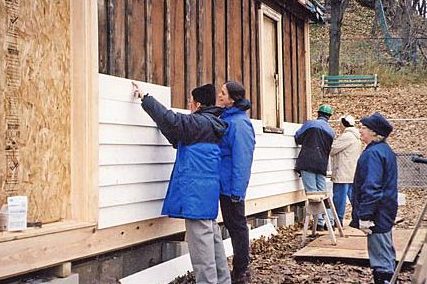
Our tollhouse is the oldest tollkeeper’s house surviving anywhere in Canada open for viewing by the public and among the oldest still existing. It is constructed in very rare vertical plank construction (no framing), held in place by bottom and top sills (huge beams). This was a style used for a short period in the early to mid-1800s, allowing us to date it probably between 1830 and 1840. It would have operated as a tollhouse from about 1850 until the abolition of the tolling system in 1895. There are a few other buildings of vertical plank construction near Toronto, in Clareville, Grafton and Newmarket, but this is the only known one that is open to the public.
The Cottage is constructed out of white pine, felled nearby, it is believed from a single tree. Therefore, it gives insight into the once-giant forests of the escarpment. The interior allows us to see some of the furnishings and daily items of the poorer classes. Although this group made up the bulk of the population, their way of life is not usually on display in the city’s heritage residences. The Cottage was registered by the City of Toronto under the Ontario Heritage Act in 2004.
The Tollkeeper’s Cottage is owned and operated by the Community History Project (CHP), a non-profit corporation which was formed in 1983 and which gained charitable status in 2010. CHP is a member of the Ontario Historical Society and the Ontario Museum Association.
LOCATION AND FUNCTION
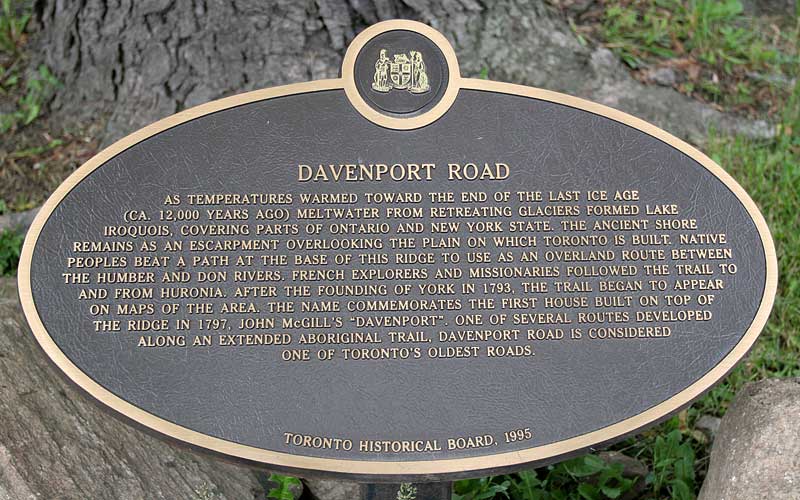
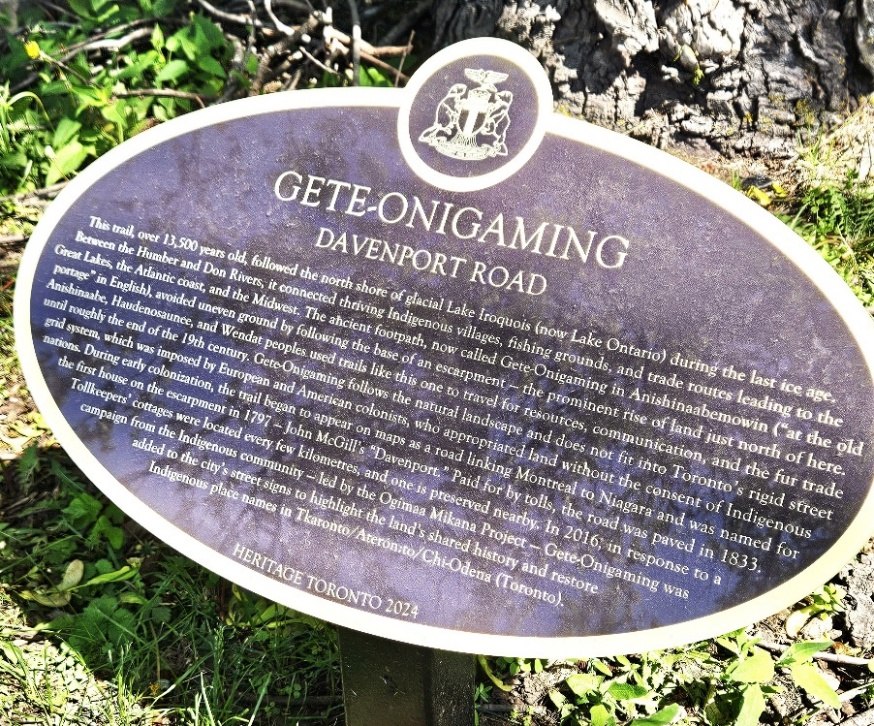
The Tollkeeper’s Cottage was located during its life of tollkeeping at the corner of Bathurst Street and Davenport Road. Davenport Road has a long history of human use that can be traced back to the end of the Ice Ages, when the passageway was used as an ancient foot path by Indigenous people seeking an overland route from Montreal to Niagara. It continued to be an important trail for French fur traders in the 1600’s, and for the first European settlers who arrived in the area in the 1790’s, and was slowly converted into a built road during the 19th century. (history of Davenport Road in more detail is given here).
In nineteenth century Toronto, in what was then known as Upper Canada, roads were just muddy trails, waterlogged after rain and slippery in winter. Major improvements began in 1833, when the government of Upper Canada authorized private companies to build, improve and maintain roads, in return for which they were permitted to collect tolls from the roads’ users.
The companies built tollgates and hired men to operate them. Between the Humber and Don Rivers, Davenport Road had five tollgates. Our Cottage is Tollgate #3, a combination tollgate and tollkeeper’s family residence. Until 1895, it sat at a location now buried under the asphalt of Davenport Road and Bathurst Street. To find out more about the tollgates their functioning, click here .
DISCOVERY
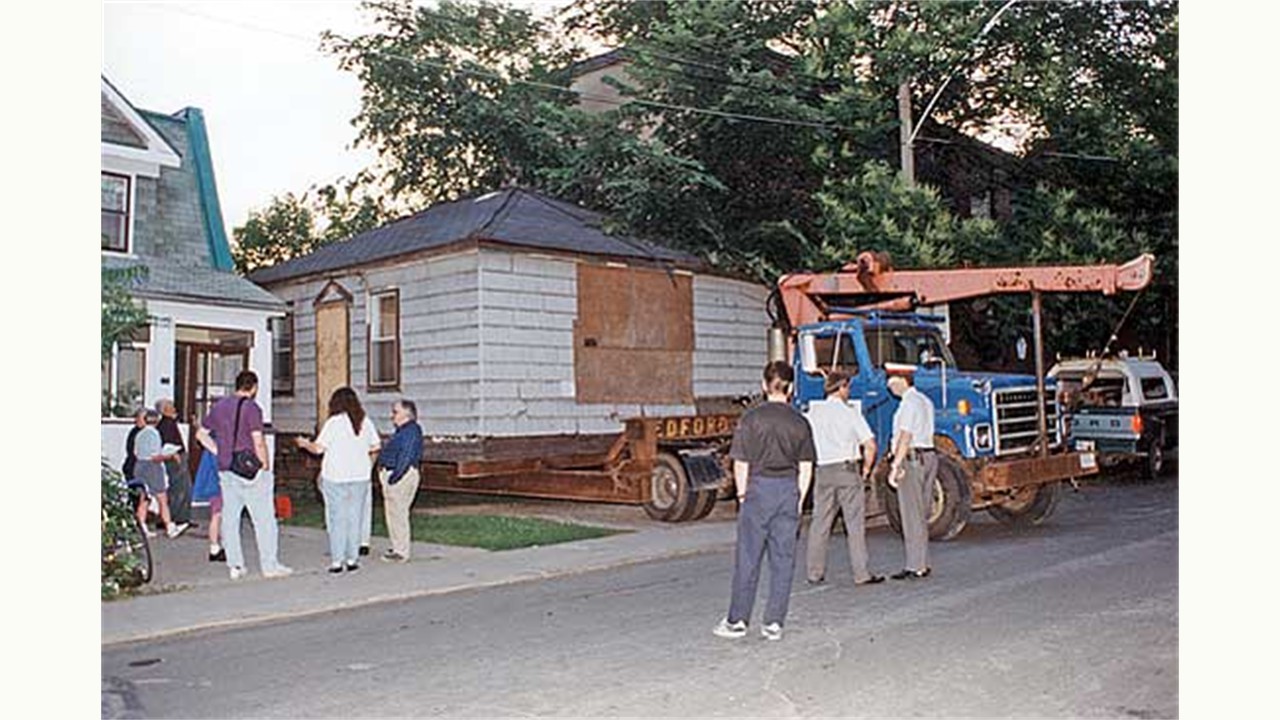
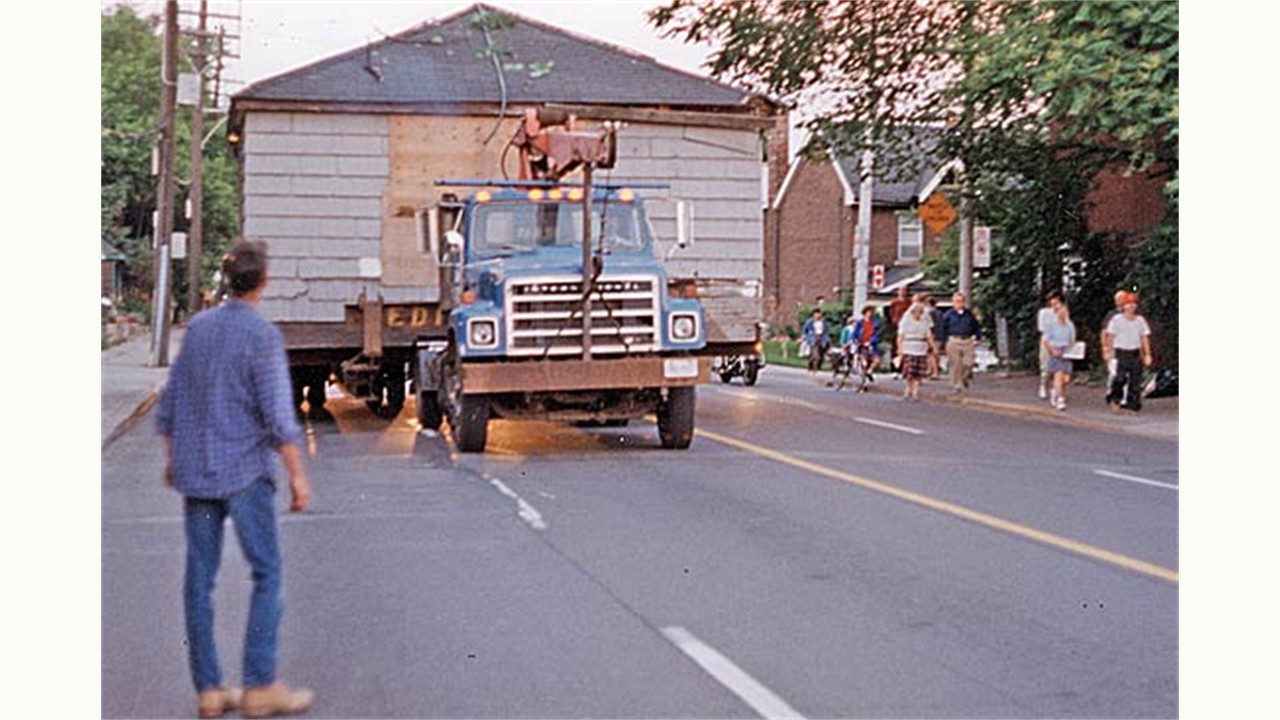
Moved and transformed several times over the intervening 150 years, the Tollkeeper’s Cottage–minus its front porch and rear addition–was “discovered” in 1993 on Upper Howland Avenue on the property of Stefan and Betty Zatko. A developer, Victory Estates, intended to build townhouses on the property. A neighbour, Kulli Milles, notified the Community History Project about the old and rare Cottage, and at the request of the Community History Project, the developer sold the Cottage for $1. and delayed demolition for 30 days so the Cottage could be removed from the property. In June 1996, the TTC came to the rescue and offered their repair site at Christie and Wychwood as a temporary holding place . The CHP then began the fundraising necessary to restore it as a museum.
Toronto City Council kindly gave permission for the Cottage to be placed as close as possible to its original site while restoration took place. This spot, once a TTC bus turnaround, is now rented at a nominal fee to the Community History Project and the park was renamed the Tollkeeper’s Park.
RESTORATION
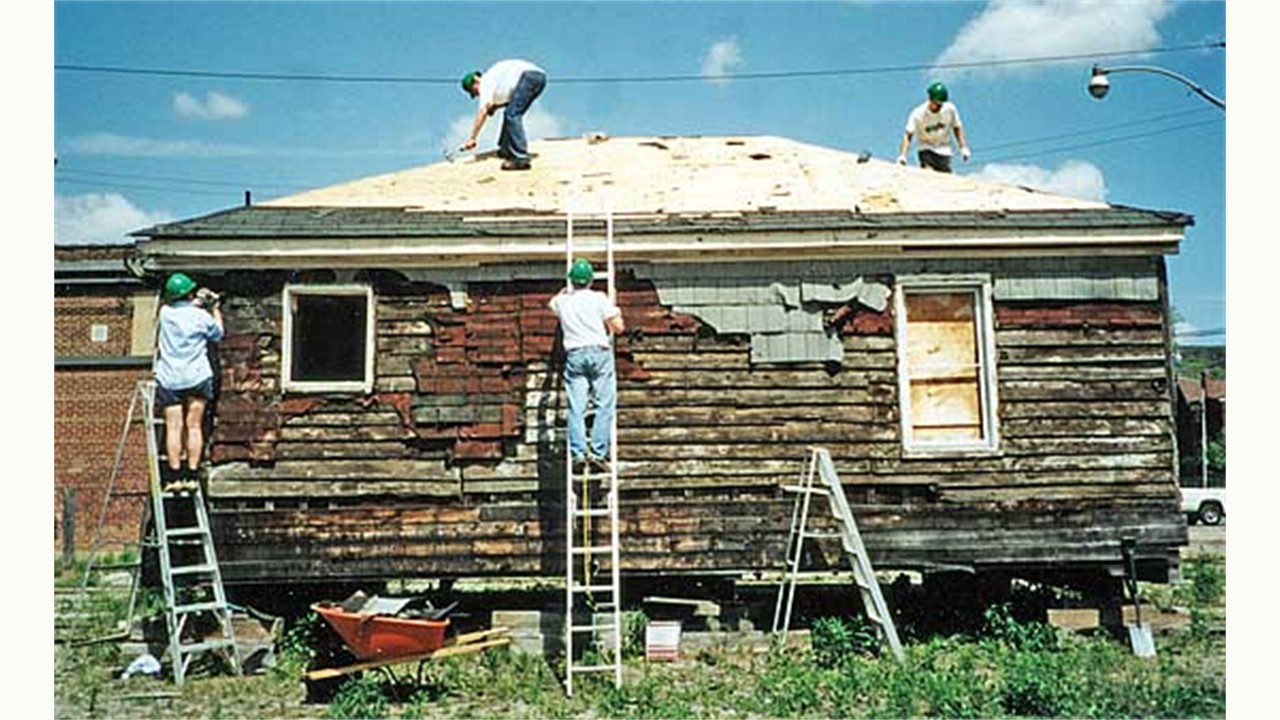
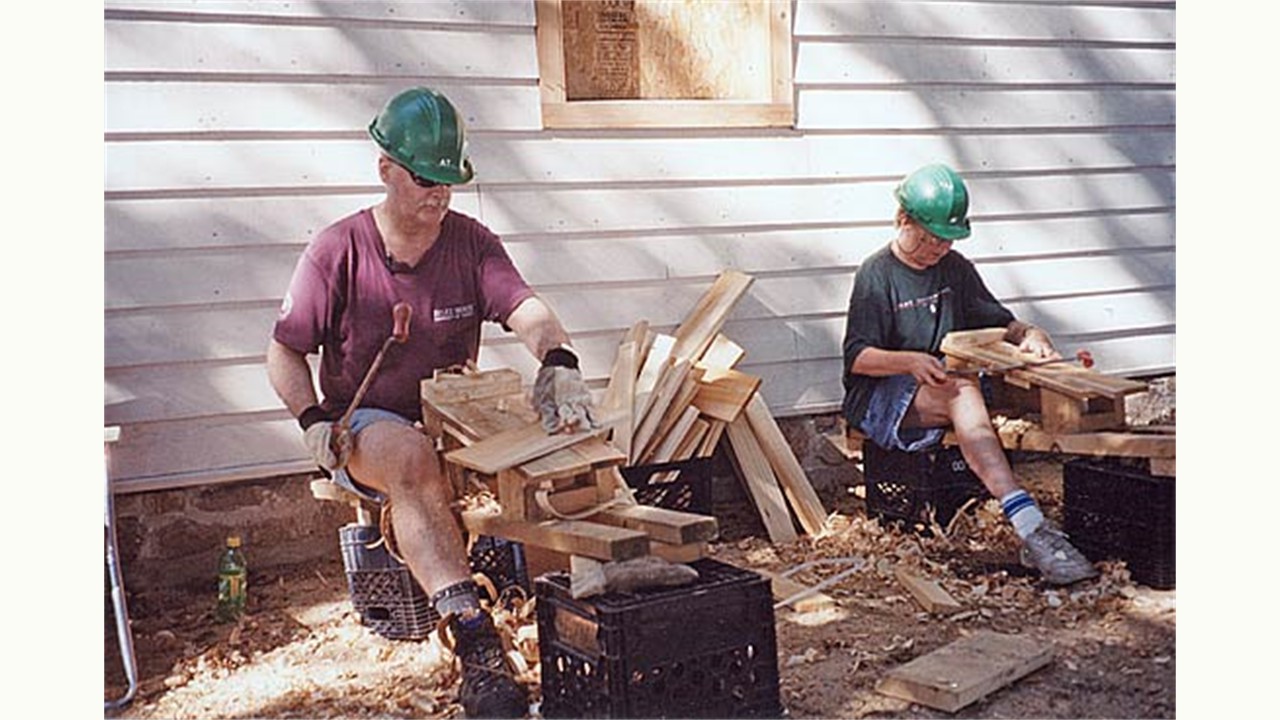
Restoration was a challenge as records of the Cottage were lost in a fire in 1881, so craftspeople were needed who could determine from its construction how it should be restored according to its time period. The uniqueness of the building was well established by 2002, and heritage community volunteers lent their support with generous donations.
Volunteers removed the drywall and other signs of twentieth century wiring and plumbing. They discovered the original position of the front door and the window through which the tollkeeper would watch for traffic. Several layers of asphalt shingles were removed from the roof. Samples of the original materials were saved and are available at the Cottage for viewing.
Since the Cottage was too small to permit its use as a museum, a classroom size addition was planned that could accommodate school groups and serve as a display and instructional facility. On July 7, 2002 a house mover transported the cottage to the new site and the process began of stripping away the more recent layers and analyzing the findings.
A search began for stones for the original foundation floor. A mason was needed who could make mortar as it would have been made in 1835, and who could create a suspended chimney from old bricks. In the meantime, volunteers were hand-splitting and shaping cedar shakes for the roof and created plaster walls and laths for the interior.
Inside, the original floorboards were numbered, removed and hand washed. Woodwork from the door and windows was removed and re-installed
click here to see a slide show of the discovery and renovation<
In September 2004 the City of Toronto designated the Tollkeeper’s Cottage a historic site under the Ontario Heritage Act, Part IV.
Click here to see more about the over 500 individuals, organizations and companies who helped in this restoration, which was supported by a grant from the Trillium Foundation.